Embouchure problems are rarely only technical
When a wind player who could play normally suddenly cannot, the assumption is usually that something has gone wrong with the technique. In my experience the picture is more complex than that — and one of the four factors involved can now be imaged directly.
Four factors worth evaluating
After presenting this diagnostic and treatment approach at the Performing Arts Medicine Association conference in London in 2024, I had a great many questions from musicians and physicians overseas, which is what pushed me to set the method out in full. It was published in early 2025.
1 · Breathing and air support
When a musician is not using the diaphragm efficiently, the body compensates — overusing the neck muscles, overusing the lip muscles, or pressing the mouthpiece too hard. Poor posture increases tension in the fascia around the mouth, including the superficial musculoaponeurotic system (SMAS), which contributes to overuse of the peri-oral muscles and fascia.
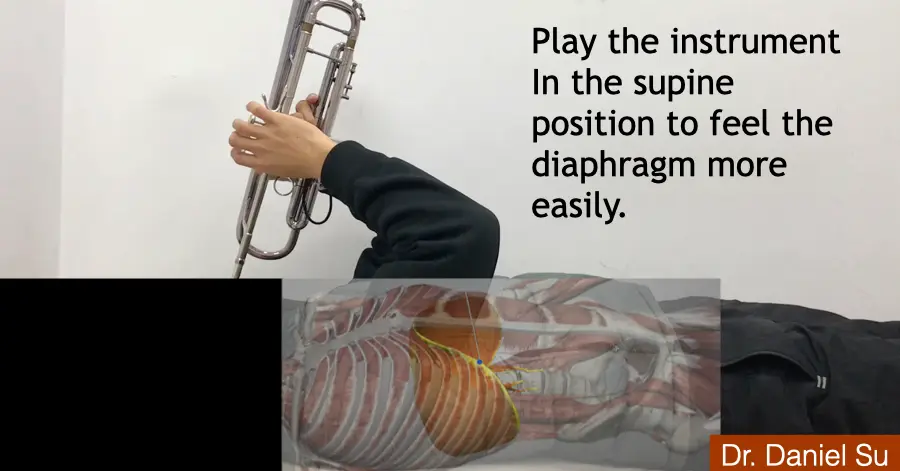
To help a player feel abdominal and diaphragmatic support more clearly, I often ask them to practise lying down for a short period before returning to an upright playing position. Offloading gravity makes the diaphragm easier to feel. Light aerobic exercise, jogging, and not smoking all help cardiopulmonary endurance and therefore efficiency of playing.
2 · Teeth alignment and jaw position
Malocclusion, a protruded jaw, temporomandibular joint dysfunction, or long-term changes in the inclination of the front teeth can force the mouthpiece or reed off centre. That produces uneven pressure around the lips and raises injury risk.
Clear aligner treatment is now considerably more practical for a working musician than traditional braces in many situations. If it is relevant, discuss timing and suitability with a qualified dentist — ideally in coordination with a physician familiar with musicians' injuries, because the timing relative to your performance calendar matters.
3 · The instrument
Mouthpiece size and angle, and reed stiffness and shape, all change embouchure loading. Different instruments generate different intra-oral pressures. On reed instruments, a harder reed places greater stress on the lips before it softens enough to play easily.
4 · Injury of the peri-oral muscles and fascia
This fourth factor is, in my view, the most important — because it is also the one that can be examined and treated most directly.
The muscles and fascia around the lips can now be evaluated in detail with high-resolution ultrasound, which makes it possible to identify structural injury, fascial imbalance and functional deficits that were previously very difficult to diagnose. The structures involved include the orbicularis oris, levator anguli oris, zygomaticus major and minor, buccinator, risorius, depressor anguli oris, the modiolus, and the superficial fascia or SMAS.
Wind players with embouchure problems may experience air leakage, tremor, poor endurance, difficulty in particular registers, poor articulation and reduced tone control. This is why ultrasound matters: it lets us understand not only the anatomy of the embouchure, but what happens under playing conditions — and it lets treatment be guided precisely.
Structural change you can see
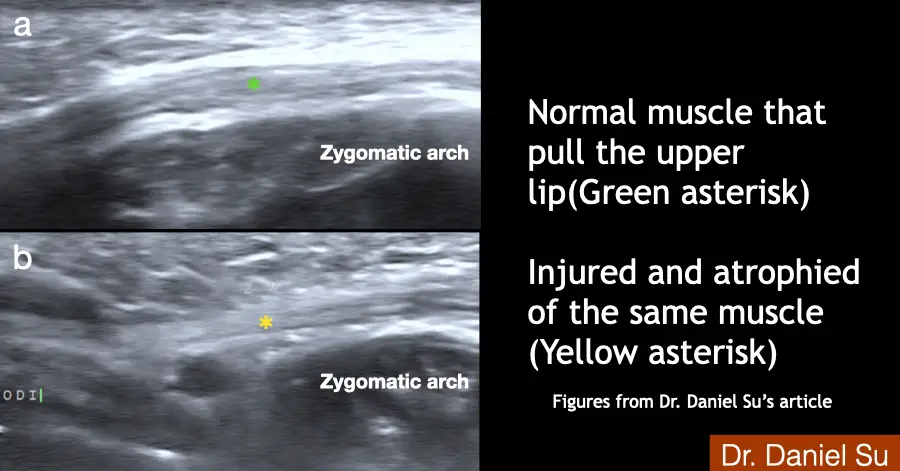
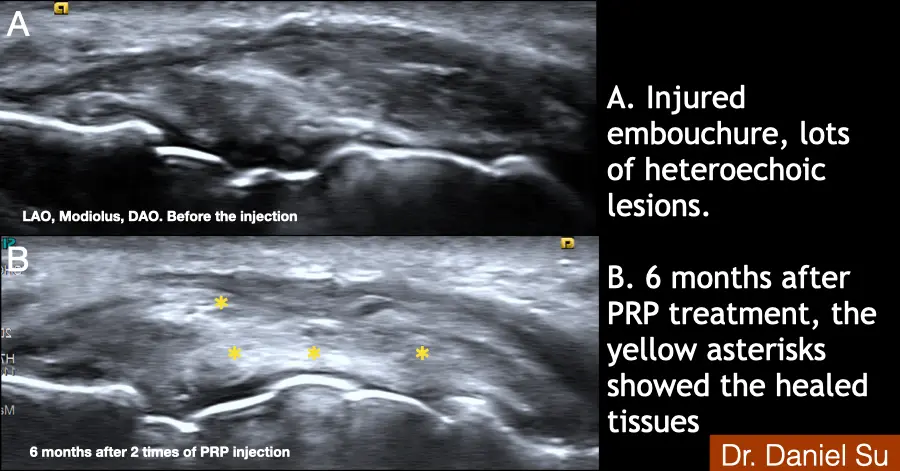
Images from Dr. Su's published work. Individual findings and individual results vary; these are illustrations of what the examination can show, not a prediction of outcome.
Treatment tailored to the instrument
Different instruments place different demands on the embouchure, and different injury patterns involve different muscles and fascial structures. Treatment therefore has to be individualised rather than standardised. Where it is appropriate, that means customised ultrasound-guided regenerative intervention — including platelet-rich plasma — chosen according to the player's instrument, playing demands and the specific tissue injured. For professional players under time pressure we also use gel-form PRP, aiming at the best recovery achievable in the shortest period.
For a wind musician, the embouchure is one of the most valuable and most delicate functional systems in the body. It deserves careful evaluation, proper protection, and precise treatment when it needs it.
Tell me what has changed in your playing.
Email your symptoms, how long you have had them, and a short video of you playing. I reply personally, and I will tell you honestly whether I think I can help before you book anything.