Diagnosis first, and diagnosis is most of the work
Two players of the same instrument, with the same complaint, can have injured entirely different structures. Until we know which, treatment is guesswork. The examination is therefore not a formality before the injection — it is the part that determines whether the injection helps.
Precision measured in millimetres
During long practice sessions, different playing postures on the same instrument lead to injury in different places. "Places" here does not mean a broad diagnosis like shoulder pain or tendinitis. It means the precise muscle, nerve and fascial region affected.
The treatment precision needed for musicians is measured in millimetres.
When we can target a structure to within one to five millimetres and identify it accurately, that is the level of precision a musician requires. Precision matters here in exactly the way it matters in music.
Ultrasound examination is operator-dependent, and that dependency is sharpest when the patient is a musician. The quality of the scanning and the experience behind it determine the diagnosis. This is also the hardest part of assessing musicians: for the same painful point, each instrument requires examining different areas and different structures. Having one region checked does not mean the rest is clear.
MOZART therapy
Over years of practice I developed a set of treatments I named MOZART — chosen because musicians remember it, which makes it easy to review which parts you need to work on.
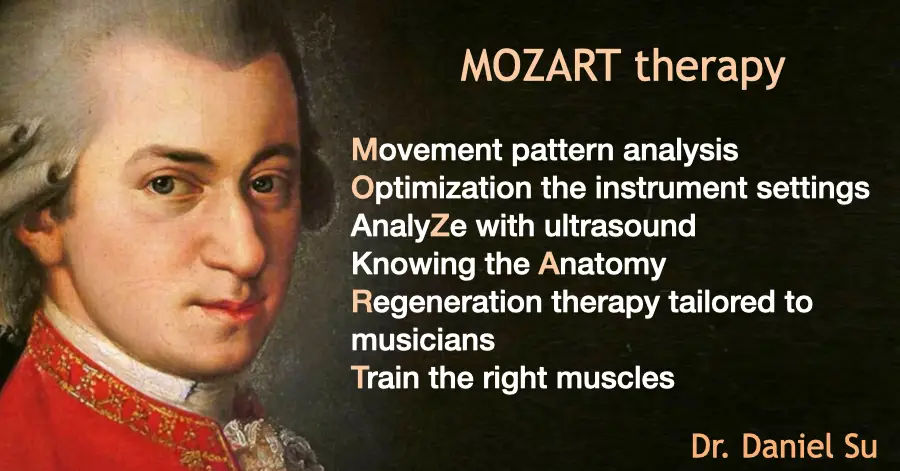
Movement pattern analysis
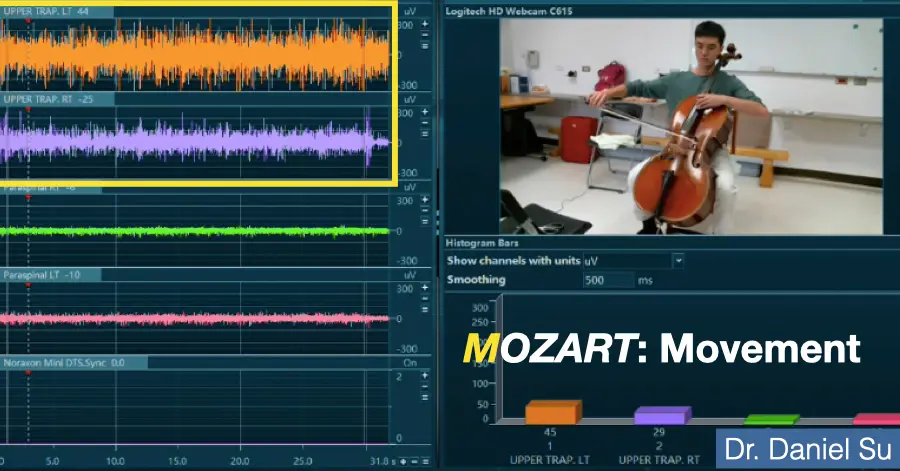
Movement means action, and more broadly both static and dynamic posture. This is the most important element of MOZART — everything stems from it. If movement is not optimised, no amount of other effort will be very effective.
But emphasising movement and trying to change posture directly is extremely difficult, and often does not succeed on its own. That is precisely why the remaining letters exist.
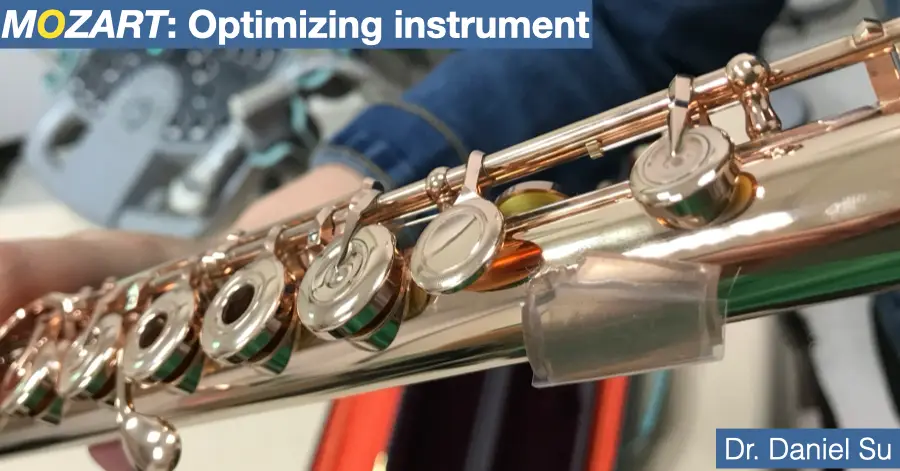
Optimisation of the instrument
Optimising the instrument and the setup around it — chairs, supports, auxiliary equipment. Because body size and the softness or stiffness of each person's fascia differ, the instrument should be adapted to the body, rather than the body forced to adapt to the instrument.
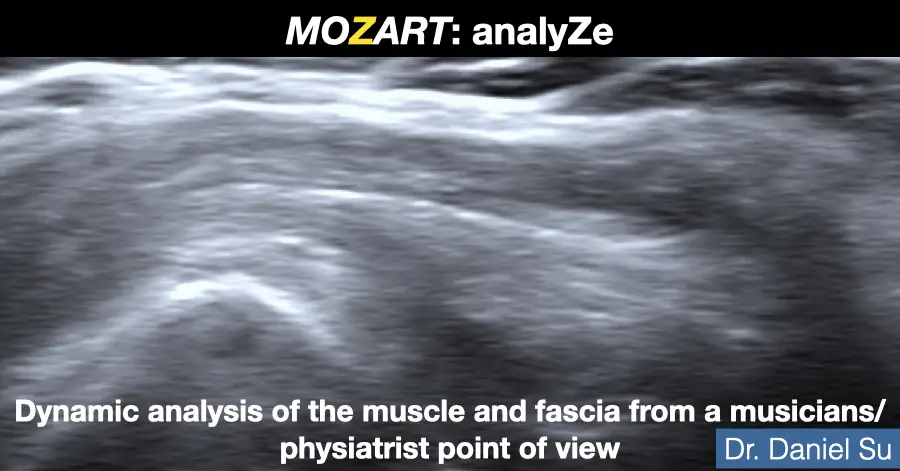
AnalyZe with ultrasound
Ultrasound is used to analyse the musculoskeletal system dynamically — not only at rest, but through the movements that actually produce the symptoms. Surface EMG is added where it clarifies which muscles are working and which are not.
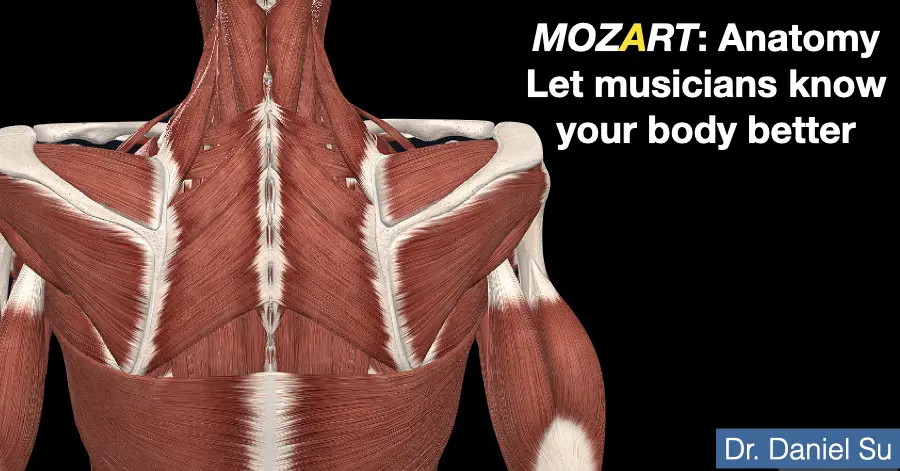
Anatomy — knowing your own body better
Playing music is an art of energy, space and time, and so is the body. The better a musician understands how to use their body, the fewer avoidable mistakes they make.
When should I stretch? Can I work out? Can I have a massage? Why does stretching help sometimes and not others? These all come down to anatomy and physiology, and the answers are not simple yes or no — they depend on your condition and your instrument. Warming up should come before playing and should be dynamic; stretching belongs afterwards. Training, where it is appropriate, should focus mainly on the back muscles and avoid gripping equipment in the hands. Massage restores tight muscles to length, but many muscles in a musician are held elongated by poor posture, and massaging those can make the soreness worse.
A great deal of what I do in the clinic is explanation. When a musician understands which structure is doing what while they play, postural corrections stop feeling arbitrary and start making sense — and corrections that make sense are the ones that actually get practised.
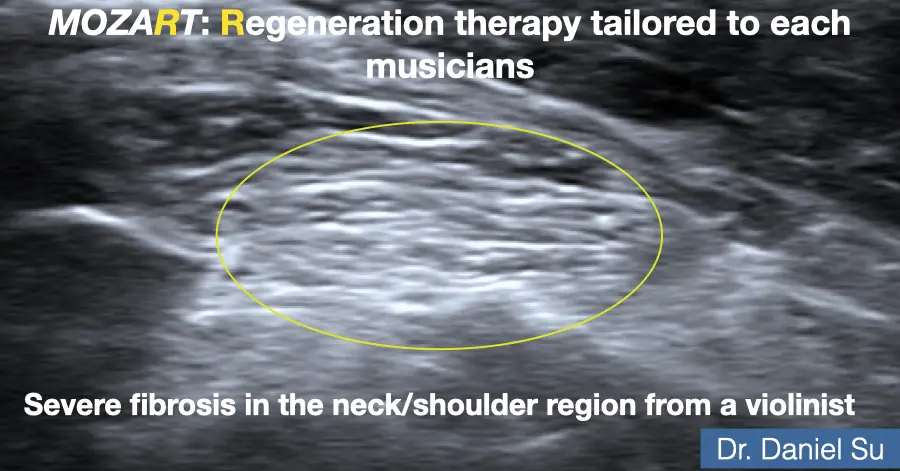
Regeneration of injured tissue
Regenerative therapy using dextrose solution and platelet-rich plasma, aimed not only at relieving pain by healing injured tissue, but at rebalancing posture into a better position for performance. Because the goal includes playing with more ease, the injection sites for a musician are entirely different from those for the general population.
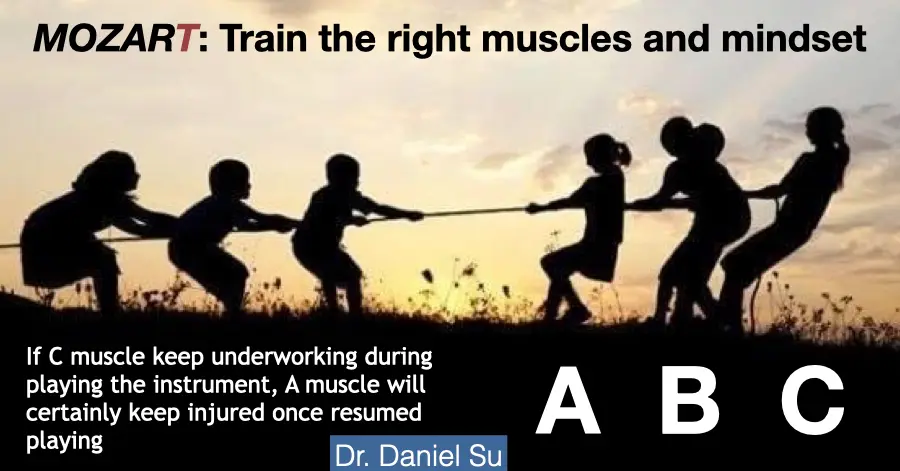
Train the right muscles — and the right mindset
In a tug-of-war, if only the people at the front pull while those at the back do not, the people at the front eventually get injured. Treating the injured person does not return the team to the contest, because the problem is the people at the back who are not pulling.
So the work is to identify which muscles are not contributing and which are overworking, in each individual performer, and to adjust them. That is ongoing for as long as you play — particularly when learning new repertoire or new technical demands.
Mindset matters too. The pursuit of musical perfection is lifelong, and thoughts of winning and losing occupy a corner of every musician's mind. Focusing on the process rather than a single result — comparing yourself honestly to your past self — reduces anxiety and stage fright, and is something you can actually control.
The treatments themselves
Ultrasound-guided platelet-rich plasma (PRP)
Platelets are concentrated from a sample of your own blood and injected, under ultrasound guidance, into the injured tendon, ligament, fascia or muscle. Because the material is autologous — it comes from you — there is no question of an allergic reaction to the injected substance itself.
Gel-form PRP
A denser preparation developed for professional players who need the best recovery achievable in the shortest period, and who are working around a fixed performance date.
Dextrose prolotherapy
Glucose solution injected to stimulate repair, used where it is the more appropriate choice, and often in combination with the above across a treatment plan.
Perineural hydrodissection
Fluid used under ultrasound guidance to free a nerve from surrounding adhesion or compression. This is relevant wherever numbness, tingling or nerve-related loss of control is part of the picture. My published work on using shear wave elastography to guide this technique is listed with the other papers.
We do not use steroids in this clinic
Steroid injections reduce inflammation quickly and have their uses. But in tissue that a musician loads heavily — tendon, ligament, fascia, muscle — they can cause atrophy and leave the tissue more prone to tearing once tension increases again. Repeated injections weaken soft tissue further. For a performer whose career depends on the quality of that tissue, the trade is not worth making.
What to expect, honestly
Injection is a medical procedure and carries the ordinary risks of one: soreness for several days, bruising, and rarely infection. Post-injection soreness is expected — it is part of the healing response rather than a sign something has gone wrong. Whether any of these treatments is appropriate for you at all is a decision made after examination, not before it, and there are musicians I examine and advise against injection entirely.
Treatment is short. Recovery is not.
These are two different numbers and confusing them causes real problems — people book a return flight around the first one and plan a concert around it too.
- 3 days to 1 week — the first trip. Examination, diagnosis and, in most cases, the first treatment at that same visit. From there it goes one of two ways: either you stay about another week for the next treatment, or you return for it two weeks to two months later. It is decided case by case, and we settle it by email before you book.
- About 6 weeks — fascia, ligament and muscle reach a more stable stage of healing. Until then, avoid intensive practice and heavy lifting. Exercises to restore muscular balance are introduced gradually after this point — the specific ones for your instrument, not general resistance training.
- 3 to 6 months — tissue recovery, depending on the original severity. Nerve injuries take longer, sometimes considerably longer, and heal gradually.
- Throughout — you continue playing, on a graded plan, with follow-up by email or Zoom. The return-to-practice schedule is here →
Tell me what has changed in your playing.
Email your symptoms, how long you have had them, and a short video of you playing. I reply personally, and I will tell you honestly whether I think I can help before you book anything.